
Things to Do in Anafi: Kalamos, Ancient Anafi, Chora and Island Walks
Anafi sits at the southeastern edge of the Cyclades, close enough to Santorini to share the brilliant Aegean light and volcanic horizons, but with a very different character.
This is a small, mountainous island built around walking, beaches, archaeology and an unusually dramatic landscape. There is one principal village, Chora, a string of beaches along the southern coast and relatively little conventional sightseeing infrastructure.
Yet Anafi has considerably more to explore than its size suggests.
Its defining landmark is Kalamos, the enormous limestone monolith rising from the eastern end of the island. Around it are monasteries, ancient religious sites and walking trails. Elsewhere, the ruins of ancient Anafi at Kastelli reveal an island with a history extending far beyond its modern population.
Here are the best things to do in Anafi.
Explore Chora
Chora is the centre of life on Anafi and the best place to begin exploring the island.
The whitewashed settlement occupies a hillside above the southern coast, with narrow lanes, small squares, churches and traditional Cycladic houses climbing across the slope.
One distinctive feature of Anafi’s traditional architecture is the old domed bread ovens attached to houses.
Chora is particularly enjoyable in the evening. Its elevated position gives views across the Aegean towards Santorini, making sunset one of the simplest experiences on the island.
Rather than treating Chora as a collection of individual attractions, allow time simply to wander through it.
The village is compact enough to explore without a plan.
Look for the Remains of Chora’s Kastro
Anafi’s medieval settlement developed around a fortified position above the modern village.
Fragments of the old Kastro survive around the upper part of Chora, although visitors shouldn’t expect a complete castle.
The importance of the location becomes much clearer from the views.
From the heights above the village, it is easy to understand why island settlements were traditionally built inland and above the sea rather than directly beside their ports.
Piracy was a recurring threat across the Cyclades, and visibility over the surrounding water was an important form of protection.
Visit the Archaeological Collection of Anafi
Anafi’s small archaeological collection provides useful context before exploring the ancient landscape.
The collection includes finds associated with ancient Anafi and its cemetery at Kastelli, including sculpture and material from the Hellenistic and Roman periods.
It isn’t a large museum.
That actually makes it well suited to Anafi: a short visit helps explain archaeological remains that otherwise appear as scattered stones and walls in the countryside.
Opening arrangements on small Greek islands can change, so check locally rather than building an entire day’s itinerary around fixed museum hours.
Walk to Ancient Anafi at Kastelli
One of the most worthwhile historical excursions is Kastelli, where the principal ancient city of Anafi once stood.
The settlement occupied a naturally defensible hill rising to more than 300 metres.
Ancient Anafi probably developed as a Dorian settlement during the first millennium BC and remained the island’s principal urban centre through antiquity.
Today the city has disappeared, but remains of its walls, buildings and cemetery survive across the landscape.
This isn’t a reconstructed archaeological park with visitor centres and labelled monuments.
It is better approached as an archaeological landscape.
Walking through the site while looking across the surrounding hills and sea gives a much stronger sense of how ancient Anafi functioned.
Find the Roman Sarcophagus
One of Kastelli’s most immediately recognisable remains is an impressive Roman-period sarcophagus near the little church of Panagia sto Dokari.
The surrounding cemetery produced evidence of Anafi’s prosperity during Roman times.
This is also a good example of something encountered repeatedly on the island: ancient structures, Byzantine churches and the modern rural landscape occupying the same places rather than existing as completely separate historical layers.
Follow Part of the Ancient Sacred Way
Ancient Anafi was connected with the worship of Apollo.
A route from the ancient city led east towards the sanctuary of Apollo Aiglitis, where the Monastery of Zoodochos Pigi now stands.
Sections of this route survive as the Iera Odos — the Sacred Way.
Parts remain stone-paved.
For walkers, this is one of Anafi’s most interesting experiences because the trail is not simply a modern hiking route through attractive countryside.
It follows a journey islanders were making more than two thousand years ago.
Visit the Monastery of Zoodochos Pigi
At the eastern end of Anafi, beneath Kalamos, stands the Monastery of Zoodochos Pigi, also known as the lower monastery or Kato Panagia Kalamiotissa.
The location was sacred long before the monastery existed.
It occupies the site of the ancient sanctuary of Apollo Aiglitis, and substantial ancient masonry was incorporated into the later monastic complex.
Look closely around the monastery precinct and the relationship between the two periods becomes apparent.
Ancient blocks, architectural fragments and sections associated with the sanctuary survive alongside the Christian buildings.
This makes Zoodochos Pigi one of the most historically interesting places on Anafi.
See Kalamos
Nothing else on Anafi dominates the island like Kalamos.
The immense limestone monolith rises approximately 460 metres above the sea at the southeastern end of Anafi and is connected to the rest of the island by a narrow isthmus.
Its scale is difficult to appreciate from photographs.
Kalamos changes appearance as visitors move around Anafi and is visible from much of the island.
The area is also environmentally important and forms part of the Natura 2000 network.
Even visitors who have no intention of climbing it should travel to the eastern end of Anafi simply to see Kalamos from below.
Hike Up Kalamos
For experienced walkers, climbing Kalamos is one of Anafi’s signature experiences.
The trail begins around the lower monastery and climbs steeply towards Panagia Kalamiotissa, the monastery standing near the summit.
This should not be confused with an ordinary walk between villages.
The route is steep, rocky and exposed, with substantial drops in places. Summer heat can make it considerably more demanding.
Proper footwear, plenty of water and sensible weather conditions are essential.
Visitors uncomfortable with heights or exposed mountain paths can experience Kalamos perfectly well from below.
There is no reason to attempt the climb simply because it appears on a list of Anafi attractions.
Reach Panagia Kalamiotissa
Those who complete the climb reach Panagia Kalamiotissa, dramatically positioned high on Kalamos.
The small domed monastery is associated with Anafi’s traditions surrounding an icon of the Virgin Mary.
Its isolation and location are more important than its size.
From the heights of Kalamos, the landscape opens across Anafi and the surrounding Aegean.
The climb has traditionally been associated with pilgrimage as well as ordinary travel, connecting the mountain with Anafi’s religious identity rather than making it merely a scenic viewpoint.
Don’t Treat the Kalamos Hike Casually
Kalamos deserves a specific warning because descriptions such as “walk to the monastery” can make the excursion sound easier than it is.
Avoid climbing during the hottest part of a summer day.
Take more water than seems necessary, wear suitable footwear and turn around if wind or conditions become uncomfortable.
Visitors should also obtain current local advice before setting out.
The lower Zoodochos Pigi Monastery is worthwhile in its own right, so travellers who decide against the summit haven’t wasted the journey east.
Discover Drakontospilo
Kalamos also contains Drakontospilo, or Dragon Cave.
The cave contains stalactite and stalagmite formations and is reached from the Kalamos trail system rather than as an easy roadside attraction.
This is another place where conditions and access matter more than ticking off a sight.
Visitors specifically interested in reaching the cave should obtain local information about the current condition of the path before attempting it.
For most travellers, Kalamos, Zoodochos Pigi and the summit route provide more than enough reason to explore this end of Anafi.
Explore the Ancient Port at Katalimatsa
Anafi’s archaeological story continues on the southern coast at Katalimatsa.
The bay was associated with the ancient port, and archaeological remains survive both around the shore and beneath the water.
Katalimatsa is also a small beach framed by distinctive cliffs.
That combination makes it particularly interesting: visitors can swim in a landscape that once served the ancient city further inland.
As with Kastelli, don’t expect a conventional archaeological attraction.
The value lies in understanding what the landscape represents.
Walk Anafi’s Old Paths
Anafi is one of those islands where walking is an attraction in itself.
Old paths connect Chora, archaeological sites, churches, monasteries and beaches.
Some routes follow tracks used for centuries, while the Sacred Way preserves a connection stretching back to antiquity.
Walking also reveals the scale of Anafi much better than travelling entirely by vehicle.
The island looks small on a map, but steep terrain, heat and exposure mean distances should not be underestimated.
Start longer walks early during summer.
Climb Mount Vigla
At around 580 metres, Vigla is the highest point on Anafi.
The summit offers extensive views across the island and surrounding Aegean.
On exceptionally clear days, several neighbouring Cycladic islands can be visible.
Vigla is much less famous than Kalamos, but keen walkers may find that part of its appeal.
It provides a different perspective over Anafi without the iconic profile that attracts visitors towards the eastern monolith.
Again, this is exposed Cycladic terrain rather than a landscaped viewpoint.
Walk to Agios Antonios
Another rewarding excursion for hikers is the remote Byzantine church of Agios Antonios on Anafi’s northern side.
The small church occupies a dramatic position above the coast and contains medieval frescoes.
Its isolation is a large part of the experience.
Agios Antonios demonstrates why Anafi shouldn’t be reduced to beaches and Kalamos. Small religious buildings scattered through the landscape preserve evidence of communities that used these routes and remote places for centuries.
It is a better excursion for walkers than for visitors trying to see the island quickly.
Spend a Day at Roukounas Beach
Anafi’s best-known beach is Roukounas, a long sweep of golden sand on the southern coast.
It has traditionally attracted independent travellers looking for a simpler alternative to heavily developed Cycladic beaches.
Roukounas is worth treating as a destination rather than merely somewhere for a quick swim.
The beach is broad enough to spend several hours here, and tamarisk trees provide some natural shade.
Anafi’s beach infrastructure remains limited compared with major islands, so arrive prepared rather than expecting a fully organised resort beach.
Swim at Kleisidi
Kleisidi is one of the easiest beaches to combine with a stay on Anafi.
Located relatively close to the port, it has fine sand and shallow water.
Its accessibility makes it particularly useful on arrival or departure days when there isn’t enough time for a longer expedition across the island.
Accommodation and places to eat can also be found around the wider Kleisidi area.
Find Agioi Anargyroi Beach
One of Anafi’s most photogenic small beaches is Agioi Anargyroi.
The little sandy cove sits beneath the whitewashed chapel that gives it its name, creating one of the island’s classic combinations of Cycladic landscape, church and sea.
It is considerably smaller than Roukounas.
That difference is useful: Anafi’s coastline offers everything from broad sandy stretches to tiny coves that feel embedded in the surrounding cliffs.
Explore More of the South Coast
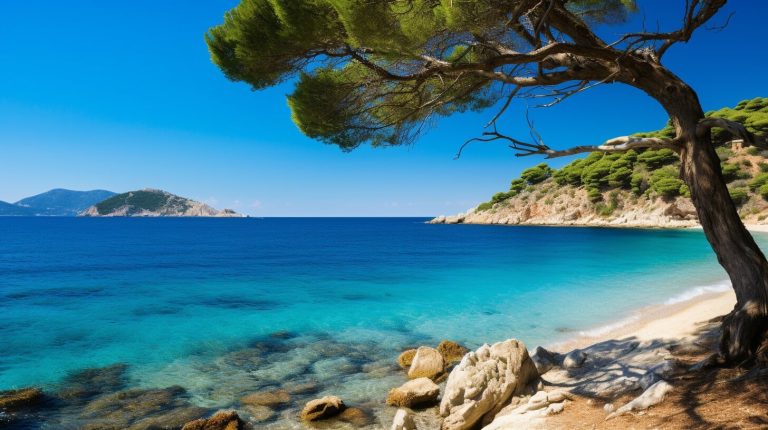
Roukounas and Kleisidi receive most of the attention, but Anafi has several other beaches along its southern coastline.
These include Katsouni, Flamourou, Katalimatsa, Megas Potamos and Agioi Anargyroi.
Rather than trying to visit all of them in a single day, choose beaches according to where a walk or excursion already takes you.
The southern coast lends itself particularly well to combining walking and swimming.
Watch the Sunset from Chora
After a day spent walking or swimming, return to Chora for sunset.
Anafi lies east of Santorini, and the neighbouring island can form part of the western horizon.
The experience is markedly different from joining the sunset crowds at Oia.
There is no single mandatory viewpoint.
Find a terrace, lane or elevated position around Chora and allow the changing light over the western Aegean to provide the attraction.
Experience Anafi After Dark
Anafi isn’t a major nightlife island, but Chora becomes much livelier during summer evenings.
Restaurants and small bars provide enough activity without overwhelming the village.
This is one reason staying on Anafi is more rewarding than trying to treat it as a quick excursion.
The rhythm of the island becomes clearer once beach visitors return, walkers finish their routes and people gather in Chora for dinner.
Anafi works best when there is no pressure to constantly move on to the next attraction.
Look for Local Festivals and Cultural Events
Religious festivals remain an important part of island life.
The celebration associated with Panagia Kalamiotissa on 7–8 September is particularly significant and connects the island’s religious traditions with the monasteries around Kalamos.
Anafi has also hosted contemporary cultural projects and exhibitions that use locations around the island rather than relying on conventional gallery spaces.
Visitors travelling during summer should check locally for events rather than assuming that the island’s small population means nothing is happening.
How Long Do You Need in Anafi?
Four or five nights gives Anafi room to make sense.
A shorter stay can cover Chora, a beach and perhaps the lower monastery, but it leaves little flexibility for walking.
With several days, visitors can devote time separately to:
- Chora and the surrounding landscape
- Kastelli and ancient Anafi
- Zoodochos Pigi and Kalamos
- Roukounas and the southern beaches
- another substantial walk or a slower beach day
Weather also matters, particularly for exposed walks.
Adding an extra day creates flexibility rather than requiring every excursion to happen regardless of wind or heat.
Is Anafi Worth Visiting?
Anafi is particularly worthwhile for travellers who like small islands that still require some effort.
Its attractions aren’t packaged into a convenient sightseeing circuit.
Ancient ruins sit in open countryside. Beaches may involve walking. The island’s most famous landmark is a mountain rather than a commercial attraction. Its most memorable monastery requires a serious climb.
That is precisely what distinguishes Anafi from more developed Cycladic destinations.
The combination of Chora, ancient Anafi, the Sacred Way, Zoodochos Pigi, Kalamos and the southern beaches gives the island considerably more depth than its size suggests.
It is not simply a quieter substitute for Santorini.
Anafi has a landscape and history of its own.
Explore More of Anafi
Continue planning a visit with:
Best Places to Eat in Anafi — tavernas, local dishes and places to eat around Chora and the coast.
Best Places to Stay in Anafi — where to base yourself in Chora, Kleisidi and around the port.
Best Beaches in Anafi — Roukounas, Kleisidi, Agioi Anargyroi and the island’s quieter coves.
Things to Do in Astypalaia — explore another distinctive island further east.
Things to Do in Amorgos — combine beaches, walking, villages and dramatic Cycladic landscapes.
One Comment