
Things to Do in Amorgos: Villages, Beaches & Island Experiences
Amorgos feels different from many of the better-known Cycladic islands.
There are whitewashed villages and beautiful beaches, but the island’s character comes just as much from its mountains, cliffs, walking trails and extraordinary views across the Aegean.
This is an island where one of Greece’s most remarkable monasteries seems to hang from a sheer rock face, ancient paths cross the mountains between villages, and small beaches sit beneath dramatic cliffs.
Amorgos also has a surprisingly deep history. The island once had three important ancient cities — Minoa, Arkesini and Aegiali — while archaeological remains are still scattered around the island today.
Then there is the sea.
The 1988 Luc Besson film The Big Blue helped introduce Amorgos’s intensely blue waters and rugged coastline to an international audience. Agia Anna remains particularly associated with the film.
For travellers who like combining swimming with walking, villages, history and exploration, Amorgos can be one of the most rewarding islands in the Cyclades.
Amorgos Quick Reference
Island group: Cyclades
Character: Rugged, traditional and relatively peaceful
Best for: Hiking, couples, scenery, beaches, traditional villages
Main town: Chora
Main port: Katapola
Second port: Aegiali
Ideal stay: 4–6 nights
Car: Useful, but not essential for everyone
Airport: None
Best-known attraction: Monastery of Hozoviotissa
Best-known beach: Agia Anna
Best sandy beach: Aegiali
Best for walking: Northern Amorgos and the Old Strata
Film connection: The Big Blue
Best bases: Katapola or Aegiali
One important thing to understand before visiting is the shape of the island.
Amorgos is long, mountainous and narrow. Trying to see everything by repeatedly travelling from one end to the other isn’t necessarily the best way to experience it.
Slow down and explore different parts of the island properly.
1. Visit the Monastery of Hozoviotissa
If you visit only one historic attraction on Amorgos, make it the Monastery of Hozoviotissa.
Built dramatically against a sheer cliff high above the Aegean, the monastery is approximately 40 metres long but in places no more than five metres wide. Its rooms and passages extend across eight levels within the rock.
The setting is extraordinary.
From a distance, the white monastery appears almost impossibly attached to the cliff.
Getting there is part of the experience. Visitors must climb steps from the road, so allow time and don’t approach it as a quick roadside attraction.
The monastery remains an active religious site, so dress appropriately. Current official information lists visiting hours of 08:00–13:00 and 17:00–19:00 daily, although I’d always check again shortly before visiting because opening arrangements can change.
Inside are Byzantine icons, manuscripts and ecclesiastical treasures.
Visitors may also encounter two Amorgian specialities associated with local hospitality: psimeni raki, flavoured with honey and cinnamon, and pasteli, made with sesame and honey.
Best for: history, architecture, views and one of the essential Amorgos experiences.
2. Explore Chora
Don’t visit the monastery and then immediately leave the area.
Spend time in Chora, the island’s capital.
Built around 400 metres above sea level, Chora is a medieval mountain settlement of narrow lanes, whitewashed houses, churches, small squares and old windmills. Above the village stands a 13th-century Venetian castle built around a prominent rock.
This is somewhere I’d explore without trying to follow a rigid sightseeing route.
Walk.
Take the wrong lane.
Find another little square.
Stop for coffee.
Return later for dinner.
Chora is particularly attractive in the late afternoon and evening when the temperature begins to fall.
Best for: architecture, cafés, dinner, photography and evening wandering.
3. Walk Up to the Venetian Castle
The rock and Venetian castle above Chora provide one of the village’s defining landmarks.
The castle dates from the 13th century, while the Church of Kyra Leousa is built into the rock itself.
The climb gives you another perspective over Chora and the surrounding mountainous landscape.
I’d combine it naturally with exploring the village rather than treating it as a separate excursion.
A simple evening could be:
Explore Chora → castle and viewpoints → drinks → dinner.
4. Swim at Agia Anna
Agia Anna is probably Amorgos’s most famous swimming location.
It’s also a good example of why the word beach can sometimes be misleading.
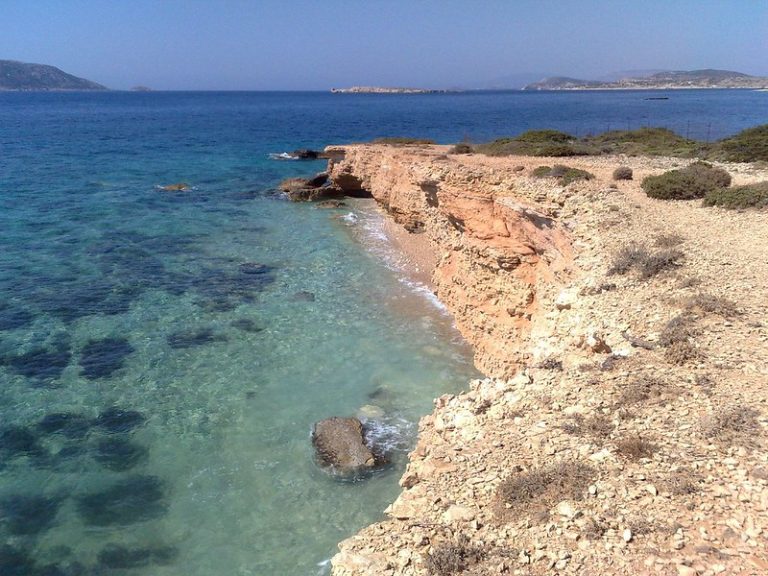
This isn’t a huge sandy resort beach. Agia Anna consists of small pebble coves surrounded by rocks and strikingly clear water. The dramatic landscape and association with The Big Blue are a large part of its appeal.
You can also see the Hozoviotissa Monastery from this part of the coastline.
I’d combine the two:
Hozoviotissa Monastery → Agia Anna → Chora
That gives you one of the best half-day sequences on Amorgos without unnecessary travel.
Best for: swimming, scenery, The Big Blue fans and dramatic coastline.
5. Spend Time in Katapola
Katapola is the main port of Amorgos, but don’t treat it merely as the place where you get off the ferry.
The bay includes Katapola itself along with the neighbouring settlements of Xilokeratidi and Rachidi, creating a larger waterfront area with restaurants, accommodation and places to walk.
Katapola is particularly useful as a base because of its relatively central position on the island.
Spend an evening walking around the harbour.
Eat beside the water.
Watch the ferries arrive.
And don’t overlook Xilokeratidi, which has a particularly attractive traditional atmosphere.
Best for: first-time visitors, ferry convenience, restaurants and a central base.
6. Discover Ancient Minoa
Above Katapola are the remains of Ancient Minoa, one of the three principal cities of ancient Amorgos.
This is exactly the sort of attraction I’d combine with somewhere you’re already visiting rather than crossing the island solely to tick off another archaeological site.
If you’re staying in Katapola, Ancient Minoa adds historical context to the landscape surrounding the modern port.
It also helps reveal just how old settlement on Amorgos really is.
Best for: archaeology, history and travellers staying around Katapola.
7. Visit Aegiali
At the northern end of the island, Aegiali provides a different experience from Katapola.
It is Amorgos’s second port and one of its main visitor centres, with accommodation, restaurants and the island’s largest sandy beach.
Aegiali works particularly well for travellers who want beach access combined with hiking and village exploration.
The surrounding area includes the hillside villages of Lagada, Tholaria and Potamos, so you can easily alternate between the coast and traditional settlements.
Even if you’re staying around Katapola, I’d devote some proper time to northern Amorgos rather than simply driving through.
8. Spend a Beach Day at Aegiali
Amorgos isn’t dominated by enormous sandy beaches, which makes Aegiali Beach particularly useful.
It’s the island’s largest sandy beach and has tavernas and beach facilities nearby.
That makes it a better choice for an uncomplicated beach day than some of the tiny rocky coves for which Amorgos is famous.
This is an important distinction.
Visit Agia Anna for the scenery.
Visit Aegiali when you actually want to spend several hours at the beach.
Families may find this distinction particularly useful.
9. Walk to Levrossos Beach
From the Aegiali area you can continue toward Levrossos.
This sandy beach has clear water and sits close to Aegiali and Tholaria.
It offers a nice compromise between convenience and feeling as though you’ve moved beyond the main village beach.
This is also a good example of how walking and swimming naturally combine on Amorgos.
You don’t always need to drive directly to a beach.
Sometimes the route there is part of the experience.
10. Explore Tholaria
Above Aegiali lies Tholaria.
This is one of the villages I’d particularly encourage visitors to explore because it introduces the mountainous northern side of Amorgos.
The local tourism organisation describes Tholaria as a place for experiencing the more authentic life of the island.
Come for a walk through the village and combine it with hiking, lunch or dinner.
Nearby are also the remains of Ancient Aegiali, one of the island’s three ancient cities.
11. Visit Lagada
Lagada is another traditional village above Aegiali.
Together with Tholaria and Potamos, it makes the northern end of Amorgos particularly rewarding for travellers who enjoy walking between settlements.
This is one reason I wouldn’t judge Amorgos solely by its beaches.
Some of the best experiences happen above the coastline, looking down toward the Aegean.
Lagada also provides access to walking routes through the surrounding mountains.
12. Walk the Old Strata
If you enjoy hiking, this should be one of the highlights of Amorgos.
The Palia Strata — Old Strata — is an approximately 11.5 km walking route connecting Chora with Aegiali via Hozoviotissa and the mountainous landscape of the island.
Greece’s official tourism organisation describes it as a challenging route taking around four hours.
This isn’t simply exercise.
The trail connects some of Amorgos’s most important landscapes and settlements and gives you a sense of how people moved around the island before modern roads.
Don’t underestimate the conditions.
In summer, heat and exposure can make hiking considerably harder than the distance suggests. Carry sufficient water, wear appropriate footwear and avoid treating midday heat casually.
Best for: experienced walkers, scenery and seeing Amorgos away from the road.
13. Explore More of the Island’s Walking Trails
The Old Strata isn’t the only option.
Amorgos has an extensive network of marked trails connecting villages, historic sites and rural landscapes.
Another substantial route is Itonia, approximately 10 km long, passing through areas including Lefkes, Kamari, Kastri and Ancient Arkesini. Official tourism information describes it as a demanding walk of around three hours.
This gives us a useful distinction:
If you’re visiting Amorgos primarily to lie on beaches, you can certainly do that.
But if you like walking holidays, Amorgos becomes much more interesting.
14. Swim at Mouros
Mouros is one of the beaches I’d make an effort to see.
The beach sits beneath high cliffs and is known for clear water and impressive rock formations. Greece’s official tourism organisation highlights both the towering rocks and the natural shade they can provide.
There is a walk down to the beach, so don’t expect the effortless access of Aegiali.
But that’s part of Amorgos.
Many of its most rewarding swimming locations require a little effort.
Best for: swimming, dramatic scenery and travellers comfortable with walking access.
15. Visit Kalotaritissa
At the southern end of Amorgos, Kalotaritissa provides another type of beach experience.
It’s a long sandy beach with clear water, some natural shade and organised facilities.
The bay’s geography also makes it feel quite different from the exposed rocky coastline elsewhere on Amorgos.
This is worth combining with other attractions in Kato Meria, the southern part of the island, rather than making repeated journeys from the north.
16. Take a Boat to Gramvousa
From Kalotaritissa you can take a small boat across to Gramvousa.
The islet has white sand and turquoise water and makes an easy extension to a southern Amorgos beach day.
This isn’t an excursion I’d necessarily prioritise over Hozoviotissa or the Old Strata on a very short trip.
But with five or six days on Amorgos, it gives you another way of experiencing the coastline.
17. See the Olympia Shipwreck
Near Liveros Bay in southern Amorgos lies the wreck of the Olympia.
The rusting ship has become one of the island’s most recognisable photographic locations and sits dramatically against the rocky coastline. Greece’s national tourism organisation specifically identifies it as one of Amorgos’s notable coastal sights.
It’s another attraction that makes sense as part of a Kato Meria exploration day.
Don’t build the whole day around getting one photograph.
Combine the shipwreck with Kalotaritissa and other southern stops.
18. Visit Agios Pavlos and Look Across to Nikouria
Agios Pavlos sits on the coast between the central and northern parts of Amorgos.
The narrow peninsula of pale pebbles and sand extends into clear blue water directly opposite the islet of Nikouria.
Boats can take visitors across to Nikouria, making this another place where a beach visit can become a small excursion.
It’s also a useful stop when travelling between Katapola/Chora and Aegiali.
Best for: swimming, views and combining with northern Amorgos.
19. Explore Ancient Arkesini
Ancient Arkesini, also known as Kastri, was another of Amorgos’s three ancient cities.
Its acropolis remains one of the more important archaeological landscapes in the southern part of the island.
This is particularly worthwhile if you’re already exploring Kato Meria.
It helps connect modern Amorgos with a settlement history stretching back thousands of years rather than presenting the island simply as a collection of pretty Cycladic villages.
20. See the Tower of Agia Triada
Near Arkesini is the Tower of Agia Triada, an ancient defensive tower and one of the island’s best-preserved ancient monuments.
This is exactly the kind of lesser-known attraction that makes a slower exploration of southern Amorgos worthwhile.
Rather than:
Chora → beach → Chora
consider devoting a whole day to the south.
That gives the journey itself a purpose.
21. Visit the Archaeological Museum in Chora
The Archaeological Museum of Amorgos is housed in the historic Gavras Tower in Chora.
Its collection brings together finds associated with the island’s three ancient cities and covers periods including Cycladic, Hellenistic, Roman and Early Christian history.
I’d visit it while you’re already exploring Chora.
Museums like this are particularly valuable after you’ve seen places such as Ancient Minoa or Arkesini because objects that might otherwise seem abstract suddenly have a geographical context.
22. Try Psimeni Raki
Amorgos has its own characteristic drink: psimeni raki.
Unlike ordinary raki or tsikoudia, the Amorgian version is flavoured with ingredients including honey and cinnamon. Greece’s official tourism information specifically associates it with the island and the hospitality of Hozoviotissa.
Try it at least once.
And this is where our Best Places to Eat in Amorgos article will become useful, because food should be part of exploring the island rather than a completely separate subject.
23. Experience a Panigyri if Your Dates Coincide
Traditional religious festivals — panigyria — remain an important part of island life.
One of Amorgos’s major celebrations takes place at Agia Paraskevi near Kalofana, while Hozoviotissa celebrates the Presentation of the Virgin Mary on 21 November.
If your visit happens to coincide with a festival, it’s worth investigating.
But don’t build an itinerary around old festival information without checking the current year’s arrangements.
24. Give Amorgos Time
Perhaps the biggest mistake you can make with Amorgos is trying to treat it as a checklist.
It isn’t an island where I’d want to arrive in the morning, photograph the monastery, swim at Agia Anna and declare the destination complete.
Its appeal becomes clearer when you have time to:
walk between villages,
sit in Chora after dark,
spend an afternoon at Aegiali,
explore Kato Meria,
take a mountain trail,
and have days where the journey between attractions matters as much as the attractions themselves.
That’s why I think four to six nights is a much better introduction than trying to squeeze Amorgos into two.
How Many Days Do You Need in Amorgos?
I’d recommend four nights as a minimum for a satisfying first visit, with five or six being better for walkers and slower travellers.
A five-day itinerary could look like this:
Day 1: Katapola and Chora.
Day 2: Hozoviotissa, Agia Anna and Chora.
Day 3: Aegiali, Tholaria, Lagada and northern beaches.
Day 4: Kato Meria, Ancient Arkesini, Olympia shipwreck and Kalotaritissa.
Day 5: hiking, beach day or boat trip to Nikouria/Gramvousa.
If you’re a keen walker, add more time rather than trying to squeeze the trails between sightseeing days.
Katapola or Aegiali?
This is one of the most important decisions when planning Amorgos.
Choose Katapola if you want:
a central location,
the main ferry port,
easy access to Chora,
and a convenient base for exploring both ends of the island.
Choose Aegiali if you want:
a sandy beach,
northern villages,
easy access to walking trails,
and a more beach-oriented stay.
Neither is universally better.
Our Where to Stay in Amorgos guide will go into this properly.
Do You Need a Car in Amorgos?
Not necessarily.
Buses connect the main settlements during the visitor season, and walkers may actually enjoy structuring part of the trip around trails and public transport.
But a car gives you considerably more flexibility, particularly for exploring Kato Meria and more remote beaches.
I’d classify it:
Car: useful, but not essential.
If you’re staying for several days and want to explore the entire island independently, it becomes much more valuable.
Is Amorgos Good for Families?
Yes, although I wouldn’t automatically choose it over every other Cycladic island for very young children.
The mountainous terrain, steps, walking access and small rocky beaches are part of its character.
Families wanting easy sand and nearby facilities should look particularly at Aegiali.
Families with older children who enjoy boats, walking and exploration may find Amorgos much more interesting.
Is Amorgos Good for Couples?
Very much so.
Amorgos is particularly well suited to couples who prefer:
quiet evenings,
walking,
traditional villages,
small beaches,
dramatic scenery,
and a less resort-dominated atmosphere.
Chora in the evening and the villages around Aegiali are particularly appealing.
Is Amorgos Worth Visiting?
Yes — but I’d recommend it most strongly to travellers who appreciate the journey between places.
The monastery is spectacular.
The beaches are beautiful.
Chora is one of the island’s highlights.
But the real strength of Amorgos is how these things fit together.
You walk an old path across the mountains.
You look down at an impossibly blue Aegean.
You arrive in a whitewashed village.
You swim beneath cliffs.
Later you’re drinking psimeni raki in a small square.
That’s a different proposition from a Greek-island holiday built around resorts and organised beaches.
And for the right traveller, that’s precisely why Amorgos is worth the extra effort.
Plan Your Amorgos Trip
As we rebuild the supporting pages, this hub should eventually link prominently to:
Best Beaches in Amorgos — Agia Anna, Mouros, Aegiali, Kalotaritissa, Agios Pavlos and quieter beaches.
Where to Stay in Amorgos — Katapola vs Aegiali vs Chora and the mountain villages.
Best Places to Eat in Amorgos — restaurants by area plus local dishes, cheeses, pasteli and psimeni raki.
One Comment