
Things to Do in Kythnos: 12 Best Things to See & Do
Kythnos is one of the western Cyclades, lying between Kea and Serifos. Although it is relatively close to Athens, it has retained a quieter character than better-known islands such as Mykonos, Paros and Santorini.
The island combines traditional villages, dozens of small bays and beaches, natural hot springs, archaeological sites and a surprisingly extensive network of walking trails. Its main settlements are Chora and Dryopida inland, Merichas at the main port, Loutra in the north and Kanala on the southeastern coast.
Here are some of the best things to do in Kythnos.
1. Explore Chora
Chora, also known as Messaria, is the island’s capital and one of the best places to experience traditional Kythnos.
The village is a maze of narrow lanes, whitewashed houses, small squares, churches and traditional Cycladic archways. Restaurants, cafés and shops bring more activity during summer evenings, but the settlement retains a relaxed atmosphere.
Rather than treating Chora as somewhere to rush through between attractions, spend some time simply wandering its streets. It’s particularly pleasant towards sunset and into the evening.
2. Discover Dryopida
Dryopida is quite different from the stereotypical white-and-blue Cycladic village.
Built between hills in the interior of Kythnos, it is characterised by narrow lanes, tiled roofs, small squares and covered passageways. The village also has a long association with pottery.
Dryopida contains several small cultural attractions, including a folklore museum and ecclesiastical collections, but the village itself is the main reason to visit.
It is also the starting point for one of Kythnos’s most unusual attractions: Katafyki Cave.
3. Go Underground at Katafyki Cave
Located at the edge of Dryopida, Katafyki Cave combines a natural cave system with galleries created during the island’s mining history.
The cave was also used as a refuge at different periods in the island’s history.
Inside are large chambers, rock formations and evidence of its former industrial use. Only part of the cave system is accessible to visitors.
Because access arrangements can change, check locally in Dryopida before planning your visit rather than relying on old opening hours found online.
4. Swim at Kolona Beach
Kolona is the most recognisable beach on Kythnos.
A narrow strip of sand connects the main island with the rocky islet of Agios Loukas, creating sea on both sides of the beach. Viewed from above, it is one of the most distinctive coastal landscapes in the Cyclades.
The relatively remote location is part of its appeal. Access can involve driving on an unsealed road, walking or arriving by boat, depending on your plans and conditions.
Try to allow enough time to enjoy the area rather than treating Kolona simply as a photography stop.
For more swimming spots around the island, see our guide to the Best Beaches in Kythnos.
5. Bathe in the Thermal Springs at Loutra
Kythnos was historically known as Thermia because of its natural hot springs.
The springs are found at Loutra on the northeastern coast, where hot thermal water reaches the sea. The springs became particularly well known during the 19th century, when Greece’s King Otto and Queen Amalia were associated with the spa facilities established here.
Today, Loutra is a pleasant seaside settlement with a small harbour, restaurants and nearby beaches.
The simplest experience is the unusual contrast of warm spring water and the cooler Aegean Sea at the shoreline.
6. Visit Panagia Kanala
Panagia Kanala is one of the most important religious sites on Kythnos.
The church stands above the sea in the settlement of Kanala and houses an important icon of the Virgin Mary. The surrounding area is unusually green by Kythnos standards and offers attractive views across the Aegean.
The Feast of the Dormition on 15 August is particularly important here and is associated with one of the island’s major religious celebrations.
Even outside festival periods, Kanala is worth visiting for its peaceful setting and nearby beaches.
7. Walk the Old Paths of Kythnos
Walking is one of the best ways to understand Kythnos.
An extensive network of old paths connects villages, chapels, agricultural areas, archaeological remains and isolated sections of coastline. The landscape is filled with traditional dry-stone walls, terraces, old farm buildings and tiny churches that are easy to miss when travelling entirely by car.
Spring and autumn are particularly attractive seasons for hiking because temperatures are generally more comfortable.
During summer, start longer walks early in the morning or later in the afternoon and carry plenty of water.
8. Visit the Archaeological Sites
Kythnos has a much longer history than its quiet modern appearance might suggest.
At Maroulas, near Loutra, archaeologists uncovered evidence of a Mesolithic settlement dating back thousands of years. It is one of the most important prehistoric sites associated with the early settlement of the Aegean islands.
Another important area is Vryokastro, the site of the ancient capital of Kythnos. Archaeological work has revealed evidence of fortifications, sanctuaries and settlement extending over a long period.
Not every archaeological area functions like a conventional ticketed attraction, so these sites are best approached as part of exploring the island’s landscape and history.
9. Explore the Castle of Oria
In northern Kythnos are the remains of the medieval Castle of Oria, also known as Katakefalo.
The fortified settlement occupied a naturally defensive position and was an important centre during the Byzantine and later medieval periods.
Today the attraction is as much about the journey and landscape as the surviving ruins.
This is a better choice for visitors interested in walking, archaeology and remote scenery than for someone expecting a reconstructed castle.
10. Spend Some Time in Merichas
Most visitors first see Kythnos at Merichas, the island’s main ferry port.
It’s easy to leave immediately for Chora or the beaches, but Merichas is worth returning to later. The waterfront has cafés, tavernas and accommodation, and the harbour becomes particularly pleasant in the evening.
Nearby Martinakia Beach provides an easy swimming option without travelling far from the port.
Merichas is also a useful base if you want convenient access to ferries, boat excursions and the western side of the island.
11. Go Beach-Hopping
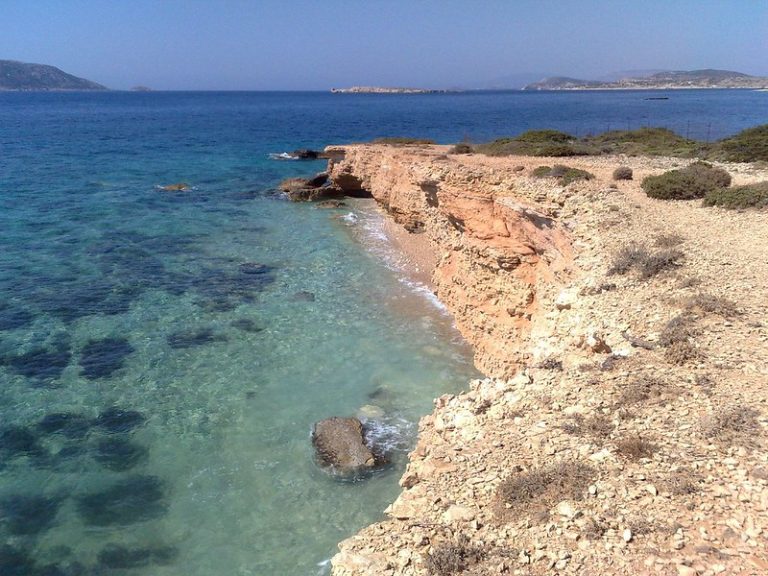
Kolona receives most of the attention, but Kythnos has an exceptionally indented coastline filled with beaches and small coves.
Among the better-known options are Episkopi, Apokrousi, Martinakia, Agios Sostis, Potamia, Agia Irini, Flabouria, Kalo Livadi and Agios Dimitrios.
Some have road access and nearby facilities, while others require more effort.
Rather than trying to find a single “best” beach, Kythnos rewards exploring several parts of its coastline during your stay.
See our Best Beaches in Kythnos guide for a more detailed look at where to swim.
12. Slow Down
One of the best things to do on Kythnos is also the simplest.
The island works particularly well for travellers who don’t want every day filled with major attractions. Have breakfast in Chora, swim at a different beach, spend the afternoon exploring Dryopida or Loutra, and finish with dinner beside the water.
Kythnos has enough to keep you occupied without making you feel that you’re constantly working through a sightseeing checklist.
That slower pace is a large part of its appeal.
How Many Days Do You Need in Kythnos?
Three days is enough for a useful introduction to Kythnos, but four or five days gives you considerably more freedom.
With three days you can explore Chora and Dryopida, visit Loutra and Katafyki Cave and spend time at several beaches.
A longer stay allows you to add walks, archaeological sites and quieter beaches without rushing from place to place.
Do You Need a Car in Kythnos?
A vehicle makes exploring Kythnos considerably easier, particularly if beaches are a priority.
The island is not enormous, but its attractions are scattered around the coastline and interior. Some beaches also involve unsealed roads or walking.
Travellers staying mainly around Chora, Merichas or Loutra can manage more simply, particularly if using local transport and taxis, but independent transport gives you much greater freedom.
When Is the Best Time to Visit Kythnos?
July and August bring the warmest weather and busiest atmosphere.
For walking and exploring, May, June, September and early October can be particularly attractive because temperatures are generally more comfortable and the island is quieter.
As elsewhere in the Cyclades, wind can significantly affect beach conditions. Having several beaches in different parts of the island makes it easier to adapt your plans.
More About Kythnos
Continue planning your trip with our guides to:
Best Places to Eat in Kythnos
Best Places to Stay in Kythnos
Best Beaches in Kythnos
One Comment