
Things to Do in Donousa: Beaches, Walking Trails and Sea Caves
Donousa is one of the Small Cyclades, lying east of Naxos and north of Amorgos. At only around 14 square kilometres, it is an island where the distances look tiny on a map and yet there is enough variety to justify staying several days.
There is no grand archaeological site, famous castle or large museum demanding attention. Donousa is better experienced through its walking trails, sandy beaches, small settlements and remarkably clear sea.
Stavros is the port and main village. From there, old paths cross the island towards Kedros, Mersini, Livadi and Kalotaritissa. Offshore, sea caves add another dimension to a place where the coastline is as important as anything on land.
Here are the best things to do in Donousa.
Explore Stavros
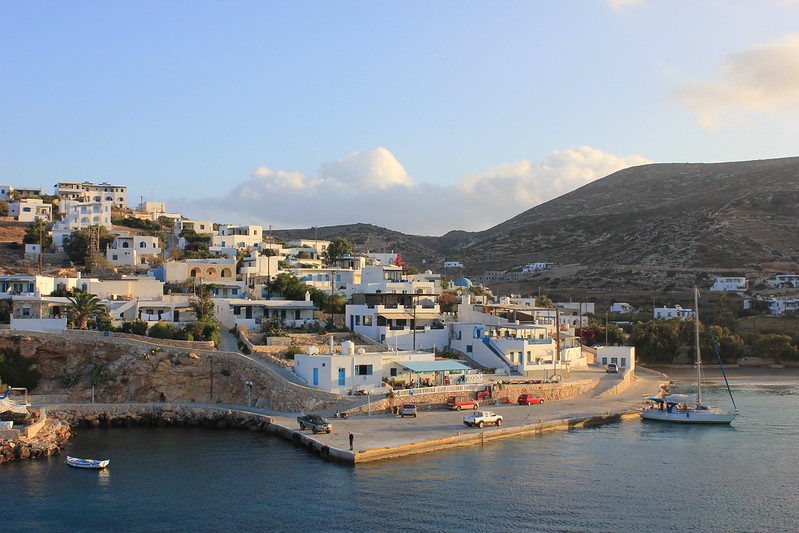
Stavros is the main settlement and port of Donousa, and almost every visit begins here.
The village curves around a sheltered bay with whitewashed Cycladic houses rising behind the waterfront. Ferries arrive directly in front of the settlement, so there is no long transfer between the port and island life.
Stavros has the greatest concentration of accommodation, tavernas, cafés and everyday services on Donousa.
It is worth exploring slowly rather than simply using it as a transport hub.
The beach beside the village also means it is possible to step off the ferry and be swimming shortly afterwards.
Swim at Stavros Beach
The beach at Stavros is the easiest on Donousa.
Its location directly beside the main settlement makes it particularly useful on arrival and departure days or when there isn’t enough time for a longer excursion.
Unlike the island’s more remote beaches, food and accommodation are close by.
The setting also provides one of the characteristic Donousa experiences: swimming while looking back towards the small white village and watching ferries occasionally interrupt the otherwise quiet harbour.
For the island’s most memorable beaches, however, continue east.
Walk to Kedros Beach
Kedros is one of the essential places to visit on Donousa.
The sandy bay lies east of Stavros and can be reached on foot, making it an easy first introduction to the island’s trail network.
Its pale sand and clear blue-green water would be enough reason to visit.
But Kedros has something else beneath the surface.
The remains of a German vessel sunk during the Second World War lie in relatively shallow water offshore.
Bring a mask and snorkel and the wreck can be seen beneath the sea.
Snorkel Over the Kedros Shipwreck
The submerged wreck gives Kedros an unusual historical dimension.
Rather than being preserved in a museum, the remains have become part of the underwater landscape.
Visibility varies with sea conditions, so calm weather provides the best opportunity to see it.
Treat the wreck as a historical site rather than a climbing frame. Snorkelling around it provides more than enough reason to enter the water.
The combination of beach, clear sea and twentieth-century history makes Kedros one of Donousa’s most distinctive places.
Follow Donousa’s Walking Trails
Walking is arguably the best way to experience Donousa.
The island has a network of marked paths connecting its villages, beaches, old agricultural areas, mills and archaeological remains.
These aren’t trails created simply to give tourists something to do.
Several follow routes once used by islanders travelling between settlements or moving agricultural products and minerals.
The distances are manageable, but the Cycladic sun makes even short walks considerably harder in the middle of summer.
Start early, carry water and treat the walking itself as part of the day rather than simply transportation between attractions.
Walk from Kedros to Kato Mylos
One particularly interesting route begins around Kedros Beach and continues towards Kato Mylos.
The old path was once used to transport a mixture of wheat and barley to the mill.
Along the way, the route passes small bays and evidence of Donousa’s former industrial activity.
An old iron furnace survives from the period when minerals extracted on the island were gathered and loaded for transport.
The trail also provides access towards Vathy Limenari and an ancient settlement.
It is a good example of why Donousa’s paths reveal much more than coastal scenery.
Visit Vathy Limenari
Vathy Limenari is a small, secluded bay reached on foot.
The beach itself is quiet and largely undeveloped, but the surrounding area has archaeological importance.
Remains of a settlement dating from the Geometric period have been identified here, providing evidence that Donousa was inhabited thousands of years before its modern villages developed.
Don’t expect a monumental archaeological complex.
The significance is more subtle: ancient remains occupying a remote landscape above a tiny Aegean bay.
Vathy Limenari works particularly well as part of the Kedros–Kato Mylos walking route.
Visit Mersini
Mersini is a small settlement on the southeastern side of Donousa.
It is markedly quieter than Stavros and occupies an elevated position above the coast.
The village is worth visiting both for its atmosphere and because it provides access to Livadi Beach and Fykio below.
Mersini also has something particularly valuable on a dry Cycladic island: a natural spring.
The combination of village, spring, walking trail and beaches makes Mersini one of the best places to spend half a day away from Stavros.
Find the Spring at Mersini
A short detour from the walking route leads to Mersini’s spring, shaded by a large plane tree.
After walking across Donousa’s dry, sun-exposed landscape, the contrast is striking.
The spring was historically important to local life, and its stone setting adds to the sense that this isn’t simply a scenic stop created for visitors.
It is one of those modest places that helps explain how people lived on a small island where reliable fresh water was precious.
Walk Down to Livadi Beach
From Mersini, a marked trail descends steeply towards Livadi, one of Donousa’s finest beaches.
The walk takes roughly half an hour under normal conditions, although the elevation change makes the return considerably more demanding.
Livadi has a long sandy shore, turquoise water and tamarisk trees providing some natural shade.
Development is minimal.
Bring water and anything else needed for the beach rather than assuming facilities will be available.
The combination of walking through Mersini and swimming at Livadi makes this one of the best days on Donousa.
Continue to Fykio
A branch from the Mersini–Livadi route leads towards Fykio, a much smaller coastal spot.
Its tiny harbour and beach provide an alternative to spending the entire day at Livadi.
Fykio is particularly appealing to visitors who enjoy exploring the coastline on foot and finding small places between the better-known beaches.
It doesn’t need to become a separate sightseeing mission.
Include it naturally while exploring Mersini and Livadi.
Go to Kalotaritissa
At the northeastern end of Donousa lies Kalotaritissa, a tiny settlement where the island road effectively runs out.
Low stone houses and the whitewashed church of Agios Georgios sit amid a stark Cycladic landscape.
Kalotaritissa feels considerably more remote than Stavros despite the island’s small size.
The surrounding bays are sheltered by the shape of the coastline and provide several places to swim.
It is worth coming here even if the beaches aren’t the main objective.
The settlement and surrounding landscape show a much quieter side of Donousa.
Walk from Stavros to Kalotaritissa
Keen walkers can reach Kalotaritissa using one of Donousa’s longer traditional routes.
The path crosses the island through a landscape of terraces, old agricultural land and former mining areas, with wide views across the Aegean.
This is a much better way to understand Donousa than simply travelling from one end of the road to the other.
During summer, however, the route is exposed.
Start early and carry plenty of water.
Visitors who don’t want to undertake the full walk can still explore shorter sections of the trail network.
Swim Around Kalotaritissa
The coastline around Kalotaritissa contains several small beaches and coves.
These are considerably quieter than Stavros and can feel isolated even during summer.
The landscape is part of the attraction: bare hills descend towards clear water with very little development between village and sea.
Nearby Tripiti provides another option for visitors willing to walk a little further.
Donousa rewards this kind of exploration. There is rarely a need to rush between beaches when the walk, settlement and coastline can form a single excursion.
Take a Boat Around Donousa
Seeing Donousa from the sea changes the scale of the island.
The inhabited southern side gives way to steep cliffs, inaccessible sections of coastline and sea caves that cannot properly be appreciated from the road.
Summer boat trips may circle parts of the island and stop for swimming, depending on weather and local operations.
Rather than relying on a fixed online timetable, ask at Stavros after arrival.
Conditions in the Aegean determine what can operate safely on any particular day.
See Fokospilia
One of Donousa’s most important natural features is Fokospilia, the Seal Cave, on the eastern coast.
The enormous sea cave has a triangular entrance and intensely clear blue water.
It is associated with the Mediterranean monk seal, one of the world’s rarest seal species.
Historically, the cave was also associated with pirates.
Fokospilia is accessible from the sea, so a boat excursion is the practical way to see it.
The cave should be treated first as a wildlife habitat rather than simply somewhere tourists are entitled to enter.
Follow local instructions concerning access and avoid disturbing seals if they are present.
Look for Mediterranean Monk Seals — From a Distance
Donousa lies within the range of the endangered Mediterranean monk seal.
Seeing one should be regarded as a privilege rather than an attraction that can be guaranteed.
Do not approach, feed or pursue seals.
Sea caves and remote beaches can be important resting and breeding habitat, which is precisely why disturbance matters.
A responsible boat operator should place the welfare of the animals ahead of providing passengers with a closer photograph.
See the Cave of the Wall
Donousa’s other notable sea cave is Spilia tou Tichou, usually translated as the Cave of the Wall.
It lies around the northwestern coastline near Aspros Kavos.
Where Fokospilia is particularly important for its wildlife associations, the Cave of the Wall is notable for its geological formations, including stalactites.
It is reached from the sea.
When conditions permit, boat trips around Donousa may incorporate both caves into the same excursion.
Walk Towards Limni and Aspros Kavos
Visitors don’t need a boat to experience the island’s dramatic northwestern landscape.
A marked trail from the Stavros area leads towards Limni, a small enclosed bay, and onward towards Aspros Kavos.
The route passes through old rural areas and provides a sharp contrast with the more frequently visited southern beaches.
Aspros Kavos is one of Donousa’s more dramatic coastal landscapes.
This is a good walk for visitors who have already explored Kedros and Mersini and want to see another side of the island.
Look for Donousa’s Mining History
It is easy to imagine Donousa as an island that has always depended on fishing and tourism.
Its landscape tells a more complicated story.
Mining took place during the twentieth century, and traces of that activity survive around old workings and the routes used to move ore towards the coast.
The furnace near the Kedros–Kato Mylos route is one of the clearest reminders.
These remains aren’t major industrial monuments, but they provide valuable information about how islanders made a living before tourism became important.
Discover the Old Windmills
Walking through the interior also reveals the remains of windmills, once essential to the island’s agricultural economy.
Grain grown or transported across Donousa had to be milled, and the old paths connected settlements and agricultural areas with these working structures.
The Kato Mylos route is particularly useful for understanding this landscape.
Rather than viewing a ruined mill as an isolated photograph, follow the path that once supplied it.
That turns a simple ruin into part of the island’s economic history.
Visit Donousa’s Churches
Like most Cycladic islands, Donousa has numerous small churches scattered through its settlements and countryside.
In Stavros, the church of Timios Stavros — the Holy Cross — is closely associated with the village and the island’s religious life.
Kalotaritissa has the whitewashed Agios Georgios, while Mersini is associated with Agia Sofia.
These are living religious buildings rather than museum exhibits.
They also provide useful landmarks when walking between settlements.
Watch the Sunset Above Stavros
For sunset, climb above Stavros towards the hill with the adjoining churches of Panagia and Agios Ioannis.
The elevated position looks west across the Aegean towards Naxos.
It is an excellent example of Donousa’s understated appeal.
There is no need for a famous sunset bar, ticketed viewpoint or crowd waiting for a particular photograph.
Walk uphill, find a place overlooking the sea and watch the light disappear behind the neighbouring islands.
Spend an Evening in Stavros
Donousa is quiet, but it isn’t lifeless after dark.
Stavros has tavernas, cafés and bars, and summer evenings can become surprisingly sociable given the island’s size.
The atmosphere is more informal than the nightlife of the larger Cyclades.
Dinner can stretch late into the evening without requiring a separate plan for entertainment afterwards.
This is another reason to spend several nights on Donousa rather than approaching it as a beach stop between ferries.
Experience a Donousa Festival
The feast of the Holy Cross on 14 September is particularly important to Donousa and associated with the main church at Stavros.
Like religious festivals elsewhere in the Cyclades, the celebration brings together worship, food, music and the island community.
Visitors who happen to be on Donousa during a festival gain a different perspective from the normal summer beach experience.
Dates and programmes should be confirmed locally because events can vary from year to year.
Don’t Rush Donousa
Donousa is exactly the wrong island for an aggressive sightseeing schedule.
Its strongest experiences are interconnected.
Walk to Kedros and swim over the wreck.
Continue along an old path and encounter evidence of mining and ancient settlement.
Visit Mersini, stop at the spring and descend to Livadi.
Travel to Kalotaritissa and walk to a quiet beach.
Take a boat when the sea is calm enough to explore Fokospilia.
None of these needs to be treated as a separate attraction with an allocated 45-minute time slot.
How Long Do You Need in Donousa?
Four nights is a good starting point.
That allows time for:
- Stavros and Kedros
- Mersini, Livadi and Fykio
- Kalotaritissa and the eastern side
- a boat trip or another substantial walk
Five or six nights works even better for travellers who want plenty of beach time.
Two nights is enough to see Stavros and Kedros, but it misses much of what distinguishes Donousa from simply being another small Cycladic beach island.
Is Donousa Worth Visiting?
Yes, particularly for travellers who enjoy walking, swimming and small islands without a long list of conventional attractions.
Donousa doesn’t compete with Naxos for archaeological monuments or Santorini for dramatic architecture.
Its appeal is more coherent than that.
The old paths, isolated settlements, sandy beaches, Kedros shipwreck, mining remains, ancient Vathy Limenari settlement and sea caves all belong to the same small landscape.
That makes Donousa an island to explore rather than an island to sightsee.
And because so much can be reached on foot, visitors experience the ground between the attractions rather than only the attractions themselves.
Explore More of Donousa
Continue planning a visit with:
Best Places to Eat in Donousa — tavernas and local food in Stavros, Mersini and around the island.
Best Places to Stay in Donousa — choose between Stavros, Mersini and quieter accommodation near the beaches.
Best Beaches in Donousa — explore Kedros, Livadi, Stavros, Kalotaritissa and secluded coves.
Things to Do in Schoinoussa — explore another of the Small Cyclades.
Things to Do in Amorgos — discover villages, monasteries and walking routes on Donousa’s larger neighbour.
One Comment