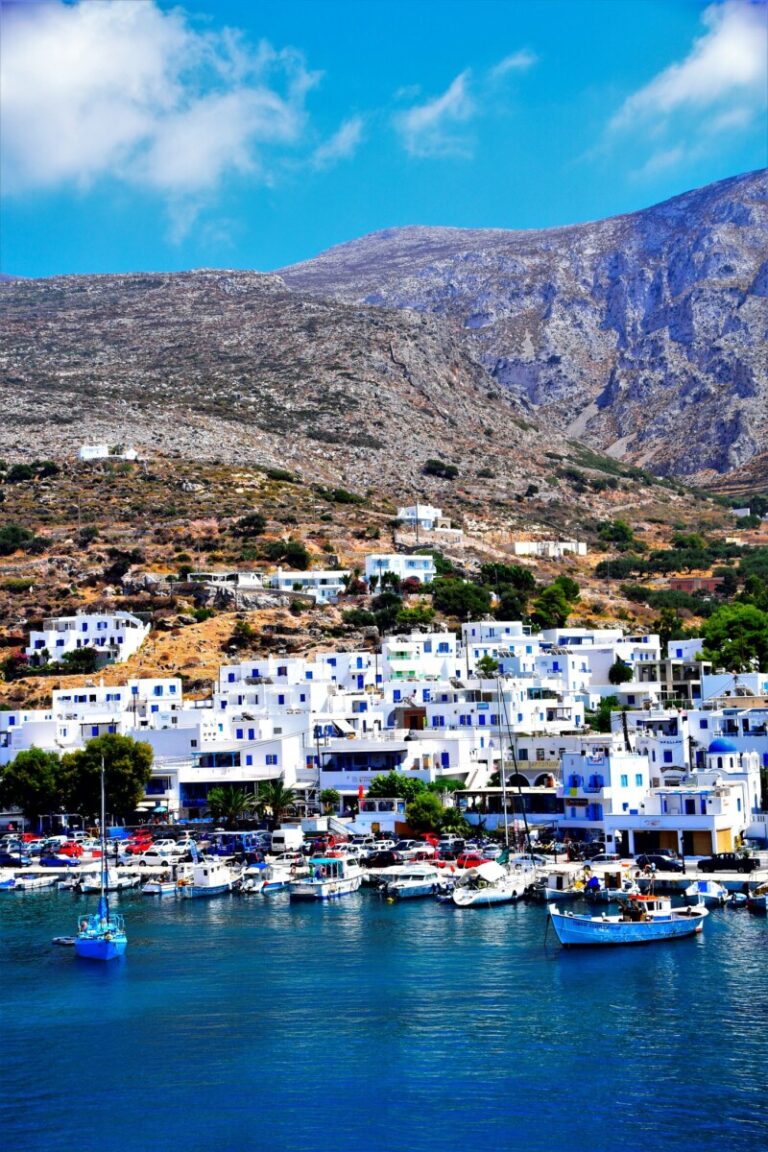
Best Beaches in Thirasia: Where to Swim
Thirasia isn’t an island you visit for long stretches of golden sand or organised beach clubs.
Its volcanic origins have created a steep and rugged coastline dominated by dark rock, black pebbles and deep water. As a result, there are only a few easily accessible places to swim.
That’s not necessarily a disadvantage.
Thirasia’s beaches are quiet, dramatic and almost completely different from the heavily visited beaches across the water on Santorini. If you value clear water, volcanic scenery and uncrowded swimming, they can be extremely rewarding.
The two principal swimming areas are Agia Irini beside Riva and Korfos beneath Manolas. Official Greek tourism information specifically identifies Riva and Korfos as Thirasia’s swimming beaches.
Beyond those, the island’s wild western coastline contains secluded coves that become much easier to explore if you have your own transport or access to a boat.
1. Agia Irini Beach at Riva
Agia Irini is the best all-round beach on Thirasia.
It lies near Riva, the island’s principal ferry port, on the northern coast.
The beach has the characteristic volcanic appearance of the Santorini island group: dark sand, black pebbles and clear deep-blue water. Ferryhopper identifies the black beach at Agia Irini/Riva as one of only a few readily accessible swimming places on Thirasia.
Condé Nast Traveller has also singled out Agia Irini as one of Thirasia’s best volcanic beaches, describing an extended shoreline of black sand and volcanic pebbles that remains remarkably quiet even during summer.
That’s probably the biggest reason to come here.
Santorini has spectacular volcanic beaches too, but you’re unlikely to mistake Agia Irini for Perissa or Kamari. Development is minimal and crowds are generally much smaller.
Best for: Swimming, volcanic scenery, easy access and travellers wanting a proper beach rather than a harbour swim.
Is Agia Irini the Same as Riva Beach?
You’ll encounter both names when researching Thirasia.
Riva is the port and settlement area, while Agia Irini is associated with the coastal area beside it.
Some sources therefore refer simply to Riva Beach, while others call the main swimming area Agia Irini Beach.
There are actually swimming areas on both sides of the bay. Exploring Greece distinguishes the beach beside Riva port from another, more isolated beach across the bay with black stones and pebbles.
For practical purposes, visitors can think of this as the Riva/Agia Irini beach area rather than assuming every website is describing completely different beaches.
Swimming at Riva
You can also swim close to the ferry harbour itself, but use common sense.
Riva is a working port, not merely a beach. The Santorini Municipal Port Fund identifies it as Thirasia’s principal road-connected port and an important gateway for goods and vehicles.
Stay away from ferry ramps, manoeuvring vessels, mooring ropes and other working parts of the harbour.
Current local beach information describes the shore around Riva as dark volcanic pebbles and stones with road access but very limited dedicated beach infrastructure.
If you’re uncertain where it’s safe to enter the water, ask locally.
2. Korfos Beach
Korfos provides Thirasia’s most dramatic swimming setting.
This tiny harbour lies at the foot of the immense caldera cliffs, directly beneath Manolas. Its shoreline consists primarily of dark volcanic pebbles, stones and pumice, with deep clear water immediately below the cliffs.
Ferryhopper identifies Korfos as Thirasia’s other principal beach and notes its pebbles and volcanic rock formations.
But Korfos isn’t a conventional beach.
It’s a picturesque working excursion harbour with tavernas, and boats regularly arrive carrying visitors from Santorini. The Santorini Port Authority specifically describes Korfos as Thirasia’s picturesque coastal settlement with traditional tavernas catering to excursion visitors.
So come here for the setting and swimming, not for rows of sunbeds.
Best for: Caldera scenery, deep-water swimming and combining a swim with lunch at a waterfront taverna.
Swimming Safely at Korfos
Korfos requires more caution than Agia Irini.
The water becomes deep relatively quickly, the seabed and shoreline are rocky, and boats operate around the harbour.
Recent beach information specifically warns swimmers to assess boat movements and mooring lines before entering the water.
I’d bring water shoes or other suitable footwear because the volcanic stones aren’t particularly comfortable under bare feet.
Korfos also isn’t my first choice for families with small children.
For experienced swimmers, however, the combination of clear water and towering caldera cliffs makes it one of Thirasia’s most memorable swimming spots.
Getting to Korfos
There are two principal ways to arrive:
By boat, which is how many Santorini day visitors reach Korfos.
Or:
On foot from Manolas.
The second option deserves some explanation.
Manolas is hundreds of steps above the harbour. Official port information confirms that Korfos has no road connection to the rest of Thirasia; land access is by the paved steps descending the cliff.
Different sources count the steps slightly differently, but roughly 270–300 steps is a reasonable expectation.
Walking down for a swim is straightforward for reasonably fit travellers.
Remember that unless you’re leaving by boat, you then have to climb back up.
In summer heat, that can be substantially harder.
3. The Remote Western Coast
This is where Thirasia becomes more interesting for adventurous visitors.
The island’s western side faces away from the Santorini caldera and contains a much less developed volcanic coastline.
Local Thirasia tourism information says there are several attractive beaches on the western side of the island, but that visitors generally need their own vehicle to reach them.
These aren’t places where I’d promise readers:
sunbeds
lifeguards
restaurants
showers
toilets
or even consistently easy access.
Think instead in terms of wild volcanic coastline and secluded coves.
This can be very rewarding, but travellers should be self-sufficient.
Bring plenty of water, food, sun protection and appropriate footwear.
4. Exploring the Coast by Boat
A boat opens up considerably more of Thirasia’s coastline.
This is arguably the best way to experience the island if swimming is a major part of your visit.
Thirasia’s volcanic cliffs and irregular shoreline create small coves and swimming locations that aren’t practical to reach overland. Local tourism information specifically notes that visitors with a boat have substantially more options.
Many Santorini sailing and caldera excursions pass Thirasia, although not every tour includes an actual swimming stop at Thirasia.
Check the itinerary rather than assuming it does.
If you’re arranging a private boat, ask the skipper about suitable swimming locations based on the wind and sea conditions that day.
Is Thirasia a Good Beach Island?
This depends entirely on what you mean by a good beach island.
If you’re looking for:
long sandy beaches
beach clubs
sunbeds and umbrellas everywhere
water sports
lifeguards
large beachfront resorts
then no.
There are much better choices elsewhere in Greece.
But if you want:
volcanic scenery
clear water
very small crowds
natural coast
quiet swimming
a chance to explore by boat
then Thirasia has considerable appeal.
The mistake would be comparing it with Naxos, Paros or even Santorini’s developed beach resorts.
Which Is the Best Beach in Thirasia?
For most visitors:
Best overall — Agia Irini
This is the closest Thirasia comes to a conventional beach and is the one I’d recommend to somebody primarily interested in swimming.
Best scenery — Korfos
You swim beneath the caldera cliffs with Santorini across the water.
Best for solitude — western coast
If you have transport and are prepared for minimal facilities.
Best for exploration — by boat
A boat provides access to parts of the volcanic shoreline that most visitors never see.
Which Beach Is Best for Families?
I’d choose the Agia Irini/Riva area, while still assessing conditions when you arrive.
Korfos has deeper water, rocky entry and boat traffic, making it less attractive for young children.
Even at Agia Irini, don’t expect the extensive family infrastructure of a major resort beach.
There may be no lifeguard, and facilities can be limited.
Parents should assess wind, waves and water conditions themselves before swimming.
Are There Sandy Beaches?
Yes—but don’t expect conventional golden Cycladic sand.
Thirasia’s beaches reflect its volcanic geology.
Agia Irini combines black volcanic sand and pebbles, while Korfos is considerably rockier.
If soft pale sand is one of your main priorities when choosing a Greek island, Thirasia probably isn’t the destination for you.
Are the Beaches Organised?
Generally, very little.
There is some conflicting information about the precise level of seasonal organisation around Agia Irini. One travel source reports sunbeds and umbrellas there, while other recent descriptions characterise the Riva shoreline as essentially unorganised or minimally serviced.
Rather than promise facilities that may disappear seasonally, I’d plan as though you need to bring what you require.
That means:
- drinking water
- sunscreen
- hat
- towel
- water shoes
- snacks
- shade where appropriate.
At Korfos, tavernas provide food and drink nearby, but that doesn’t turn the shoreline into an organised beach.
Do You Need Water Shoes?
I’d recommend them.
Black pebbles, volcanic stones and rocky entry are characteristic of Thirasia’s principal swimming areas.
Water shoes are particularly useful at Korfos.
They’re not essential for every swimmer, but they’re one of the few items I’d specifically pack for a Thirasia beach day.
What About Snorkelling?
Thirasia’s clear water and rocky volcanic coastline make snorkelling potentially worthwhile.
The less-developed coves are more interesting than expecting a major snorkelling experience inside a busy harbour.
If exploring remotely, don’t snorkel alone and remain conscious of boat traffic.
A private boat trip can be a particularly good way to combine swimming and snorkelling because a local skipper can choose an appropriate location for the day’s conditions.
Wind and Sea Conditions
This is more important on Thirasia than choosing a beach based solely on photographs.
The Riva/Agia Irini side and Korfos side face different bodies of water.
Riva is on the outer coast, whereas Korfos lies inside the Santorini caldera.
Consequently, wind and waves can affect them differently.
If Agia Irini is uncomfortable, Korfos may be more sheltered—or conditions may work the other way depending on the day’s weather and boat activity.
Ask locally.
On a small island, that can be considerably more useful than following a fixed beach itinerary.
Can You Drive to the Beaches?
Riva/Agia Irini — yes.
Riva is connected by road to the rest of Thirasia. In fact, the Santorini Municipal Port Fund says it is the island’s only port with road access.
Korfos — no road access.
You reach it by boat or by the long staircase from Manolas.
More remote parts of the western coastline may be approached using the island’s roads and tracks, but don’t assume every cove is vehicle-accessible right to the water.
Can You Walk to the Beaches?
Yes, but Thirasia’s terrain matters.
Agia Irini is easily combined with Riva.
Korfos is connected to Manolas by the famous staircase.
Walking to more remote sections of coast can involve heat, rough surfaces and substantial elevation changes.
In summer, take far more water than you think you’ll need.
Can You Camp on Thirasia’s Beaches?
No beach on Thirasia should be treated as an informal free campsite.
I have found no reliable evidence of an authorised organised campsite operating on Thirasia.
Greek restrictions on camping outside authorised facilities include beaches and other public areas, so the existence of an empty volcanic cove doesn’t make camping there permissible.
This is particularly relevant on Thirasia because the undeveloped coastline can make wild camping look as though it would be acceptable.
Visitors should use legitimate accommodation instead.
Can You Take a Campervan to the Beach?
Being able to transport a vehicle to an island is different from having permission to camp in it wherever you choose.
Riva handles vehicle ferry traffic and connects with Thirasia’s road system.
That doesn’t mean a motorhome can simply park beside Agia Irini and establish an overnight campsite.
Anyone travelling with a campervan should confirm legal overnight arrangements before bringing it to such a small island.
When Is the Best Time to Swim?
For most visitors, June through September provides the most obvious swimming season.
July and August bring the warmest holiday conditions but also stronger summer tourism and potentially stronger Meltemi winds.
June and September can be particularly attractive if you want warm weather with fewer visitors.
Thirasia is rarely overwhelmed in the way Santorini can be, but the difference is most noticeable around Korfos, where excursion boats can create a sudden influx of daytime visitors.
If you’re staying overnight, an early-morning or late-afternoon swim can be wonderfully quiet.
Should You Visit Thirasia for the Beaches?
I wouldn’t travel to Thirasia only for its beaches.
That’s not the island’s greatest strength.
Come for the combination of:
Manolas and its caldera views
traditional villages
walking
volcanic landscape
quiet tavernas
the contrast with Santorini
and swimming in clear volcanic water.
The beaches complement that experience rather than defining it.
For most visitors, Agia Irini is the best place for a proper swim, while Korfos provides the most memorable setting.
And if you have access to a boat, the wild coastline gives you considerably more possibilities.
That’s a more accurate picture of Thirasia than pretending it has ten famous beaches.