
Best Places to Eat in Amorgos: Restaurants & Local Food
Food is one of the pleasures of travelling slowly around Amorgos.
This isn’t an island where you need to spend your holiday chasing a list of famous restaurants. Some of the best meals fit naturally into the geography of your day: dinner in Chora after exploring its whitewashed lanes, seafood around Katapola harbour, a relaxed meal in Aegiali after the beach, or traditional cooking while exploring Kato Meria in the south.
Amorgos also has several foods that are genuinely associated with the island.
Patatato, local goat, xinomizithra cheese, xerotigana and psimeni raki give you plenty to look for beyond generic Greek favourites. The island’s tourism organisation identifies patatato, Amorgiani salad, xerotigana and psimeni raki among the characteristic tastes of Amorgos.
So rather than asking only:
“What is the best restaurant in Amorgos?”
I’d also ask:
“Where will I be when it’s time to eat?”
On a long mountainous island like Amorgos, that’s often the more useful question.
Where Is the Best Area to Eat in Amorgos?
There are three main restaurant areas to understand.
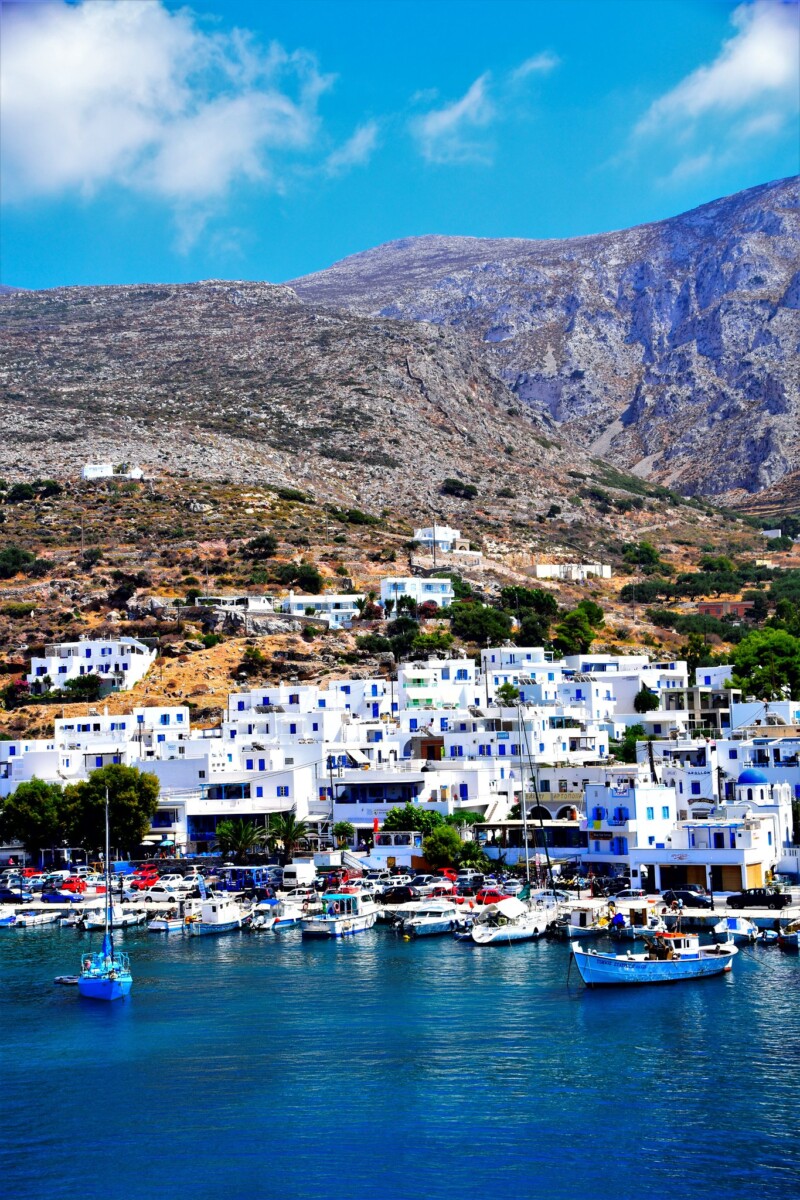
Katapola is the practical choice. It’s the main ferry port and has plenty of restaurants around the bay, making it particularly convenient on arrival and departure days.
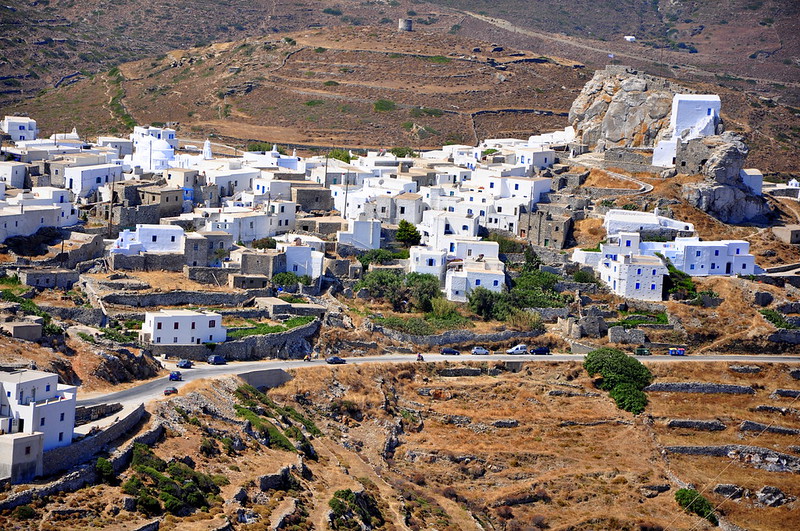
Chora is my choice for atmosphere. Come in the late afternoon, explore the village and stay for dinner rather than treating Chora as a daytime sightseeing attraction.
Aegiali combines restaurants with the island’s largest sandy beach and is particularly convenient if you’re staying in northern Amorgos.
There are also tavernas scattered through smaller villages and Kato Meria in the south.
This is one island where I’d actively encourage eating in several different areas rather than returning to the same town every evening.
Tranzistoraki – A Strong Choice in Chora
Tranzistoraki is a mezedopoleio in Chora and remains in operation, with a current official website and menu.
The restaurant emphasises good ingredients and a relaxed, social style of eating. Its current menu includes dishes using local-style ingredients such as xinomizithra, capers, lentils and cheeses.
This is exactly the kind of restaurant I’d choose when visiting Chora.
Order several dishes.
Share them.
Try something you haven’t eaten before.
And allow dinner to become part of the evening rather than something squeezed between attractions.
Best for: meze, couples, sharing dishes and dinner in Chora.
Area: Chora.
Eat in Chora After Sunset
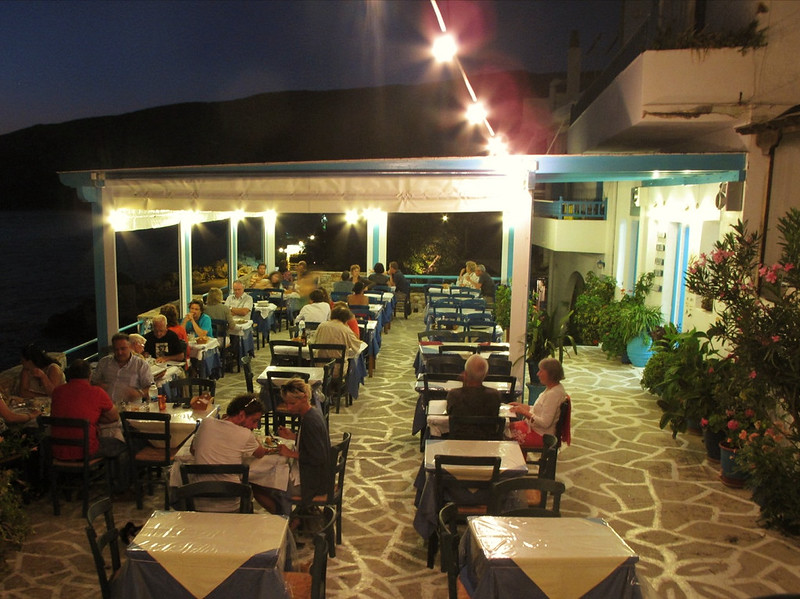
More broadly, Chora deserves at least one dinner regardless of which restaurant you choose.
The attraction isn’t simply the food.
It’s the sequence:
late-afternoon walk → village streets → sunset → drinks → dinner.
This is much more satisfying than driving into Chora solely because an online ranking tells you a particular restaurant is number one.
Restaurant rankings also change.
Chora’s atmosphere doesn’t.
If you’re staying in Katapola, I’d therefore deliberately spend one evening eating up in Chora.
Youkali – A Popular Katapola Choice
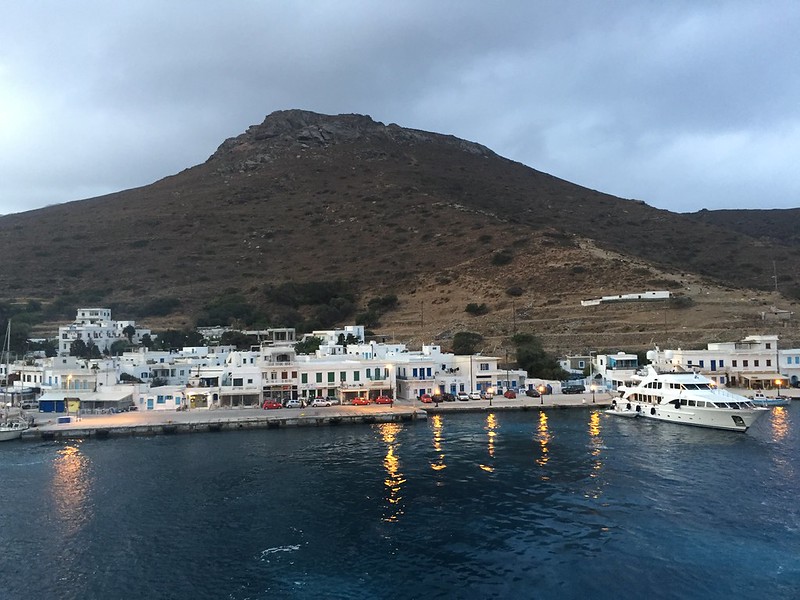
In Katapola, Youkali is currently one of the strongest-established restaurant options.
Recent 2026 restaurant listings place it among the leading restaurants around Katapola, with a substantial body of reviews and a focus on seafood and Mediterranean food.
Katapola is particularly useful for this kind of meal because you’re likely to pass through the port several times during your stay.
There’s no need to turn every dinner into another island excursion.
If you’ve spent the day exploring and return tired, eat around the harbour.
Best for: seafood, Mediterranean food and travellers staying around Katapola.
Area: Katapola.
Explore Both Sides of Katapola Bay
One mistake would be to assume Katapola means only the immediate ferry quay.
The wider bay includes Katapola, Rachidi and Xilokeratidi, and it’s worth walking around rather than choosing the first restaurant you encounter after stepping off the ferry.
This is particularly pleasant in the evening.
The harbour itself becomes part of the experience: fishing boats, ferries, waterfront tables and the surrounding hills.
Katapola is therefore my choice for convenient eating without sacrificing atmosphere.
Askas – Best for Traditional Amorgian Food in Aegiali
For somebody specifically wanting to explore traditional Amorgian cooking, Askas is particularly interesting.
The family restaurant is part of Askas Pension and Aegiali Camping and explicitly specialises in Amorgian dishes made with local products.
Its current menu description includes patatato, fava, xinomizithra, local vegetables, meat, psimeni raki, xerotigana and pasteli.
That makes Askas more useful to us than simply selecting another restaurant because it has a high numerical rating.
You can potentially try several of the foods we’re recommending elsewhere in this guide in one place.
The restaurant also describes traditional music and dancing as part of some evenings.
Best for: traditional Amorgian dishes and travellers staying around Aegiali.
Area: Aegiali.
Eat Around Aegiali Bay
Even if you don’t choose Askas, Aegiali is an easy place to eat well without planning too much.
This is especially true if you’re staying in northern Amorgos.
Spend the afternoon at the beach.
Return to your accommodation.
Walk out for dinner.
That simplicity is one of Aegiali’s advantages as a base.
Recent travellers comparing Aegiali with Katapola continue to describe both as having plenty of tavernas, with Aegiali having the stronger beach and Katapola the larger spread of places to eat and drink around its bay.
T’Apanemo – Traditional Food in Kato Meria
One restaurant I’d include specifically because of its location is T’Apanemo in Kolofana.
This gives us a recommendation in Kato Meria, rather than pretending all good food on Amorgos exists in Chora, Katapola and Aegiali.
The restaurant describes itself as a family-run traditional taverna using local meat, cheeses and vegetables, some produced by the family themselves.
Current dishes include local fava, cheese pies, patatato, local goat and other meat dishes, while psimeni raki is also available.
This is exactly where geographical planning becomes useful.
If you’re spending the day exploring southern Amorgos — Ancient Arkesini, the Olympia shipwreck, Kalotaritissa and surrounding villages — don’t automatically drive all the way back north for lunch.
Eat in Kato Meria.
Best for: traditional cooking, local ingredients and a southern Amorgos exploration day.
Area: Kolofana / Kato Meria.
What Food Is Amorgos Known For?
This is arguably more important than naming individual restaurants.
A restaurant can change ownership.
A chef can leave.
A menu can change.
But the traditional food gives us something much more enduring to recommend.
There are several things I’d actively look for during a stay on Amorgos.
Patatato
If you try only one traditional main dish, make it patatato.
It’s a characteristic Amorgian casserole made with goat meat, potatoes and herbs.
The official Amorgos tourism organisation describes it as one of the island’s principal traditional dishes and notes that it can be found in tavernas across Amorgos.
Different kitchens naturally have their own versions.
That’s part of the fun.
If you enjoy it, try it somewhere else later in the trip rather than assuming there is one definitive preparation.
Amorgiani Salad
You already know Greek salad.
Amorgiani salad gives it a local variation.
Rather than feta, the characteristic version uses Amorgian mizithra.
It’s a small change, but exactly the sort of thing I’d encourage travellers to order.
You’re still eating something familiar, but you’re tasting an ingredient associated with the island you’re actually visiting.
Xinomizithra and Local Cheese
Amorgos has a tradition of locally produced cheeses, particularly from goat’s milk.
Local tourism sources identify cheese as one of the island products worth trying or buying before leaving.
You’ll see xinomizithra used in salads and other dishes.
Tranzistoraki, for example, currently has dishes pairing it with beetroot and also uses Amorgian soft cheese with tomato and capers.
Ask what cheese is local.
That’s more interesting than simply ordering feta everywhere because you’re in Greece.
Fava
Fava is found throughout the Cyclades, but it’s also an established part of Amorgian cooking.
Askas serves it as a traditional dish, while other local food guides list it among the foods to seek out on Amorgos.
Despite the English name sometimes causing confusion, Greek fava is generally a yellow split-pea purée, not a bowl of broad beans.
It’s ideal as part of a collection of shared dishes.
Xidato
Another traditional dish worth watching for is xidato.
It belongs to the more rustic side of Amorgian cooking and appears among the characteristic local dishes identified by island gastronomy sources.
You won’t necessarily find it on every tourist-oriented menu.
And that’s precisely why it’s worth asking about when eating in a traditional taverna.
Local Goat
Amorgos’s landscape naturally lends itself to goat farming, and goat appears repeatedly in traditional island cooking.
Patatato is the obvious example, but slow-cooked or oven-cooked goat also appears independently in local food traditions.
If you’re a meat eater, I’d prioritise this over ordering an internationally familiar steak.
Kakavia and Seafood
Being an island, Amorgos naturally has a strong relationship with seafood.
One traditional dish to look for is kakavia, the Greek fisherman’s soup associated with whatever fish was available from the day’s catch. It appears among the island’s recognised gastronomic dishes.
Fresh fish may also be priced by weight.
Always ask the price before ordering if it isn’t clearly shown.
That’s good advice anywhere in Greece, not a criticism of Amorgos.
Xerotigana
Now we get to dessert.
Xerotigana are traditional fried sweets made from thin dough and served with ingredients such as honey.
They’re strongly associated with celebrations and festive occasions on Amorgos.
The island even celebrates them with a summer Xerotigano festival.
If you see them offered at a restaurant, bakery or festival, try them.
They’re much more interesting in this context than ordering a dessert you could eat anywhere.
Pasteli
Pasteli is another traditional sweet made primarily from sesame and honey.
Amorgos has its own tradition surrounding it, and the island’s tourism information identifies it as one of the characteristic products visitors can try or buy.
This also makes a good edible souvenir.
Unlike something fragile or decorative, there’s a reasonable chance you’ll actually enjoy it after returning home.
Try Psimeni Raki
One thing you should try at least once is psimeni raki.
This is probably the drink most closely associated with Amorgos.
Despite the name literally referring to “cooked” or “roasted” raki, the drink is served as a sweet liqueur. Raki is combined with honey, cinnamon and cloves, and it can be served as either an aperitif or digestif.
It has strong associations with weddings, celebrations and hospitality.
Visitors to Hozoviotissa Monastery may also encounter it as part of the monastery’s traditional welcome.
You don’t need to drink very much to experience it.
And if you like it, bottled versions are available to take home.
What Should Vegetarians Eat in Amorgos?
Although goat and seafood feature prominently in traditional Amorgian cuisine, vegetarians shouldn’t have much difficulty.
Look for:
fava, salads with local cheese, vegetable dishes, pies, legumes, locally grown vegetables and shared meze.
Current restaurant menus show plenty of examples. Tranzistoraki, for instance, lists beetroot with xinomizithra, salads, vegetable dishes and several other meat-free options.
As elsewhere in Greece, if you’re strictly vegetarian or vegan it’s worth confirming whether stocks or sauces contain meat.
Where Should You Eat for Seafood?
I’d lean toward Katapola or Aegiali.
Both give you the natural combination of harbour or seaside setting and restaurants serving fish and seafood.
But I wouldn’t automatically assume waterfront means better seafood.
Ask what’s fresh.
Ask what’s local.
Look at what other tables are ordering.
And if fish is sold by weight, confirm the cost.
Where Should You Eat for Traditional Amorgian Food?
For this particular purpose, I’d prioritise restaurants that explicitly cook local dishes rather than restaurants simply described online as “Greek”.
Askas is particularly useful in Aegiali because its current offering explicitly includes patatato, local fava, xinomizithra, psimeni raki, xerotigana and pasteli.
T’Apanemo is another strong choice when exploring Kato Meria because of its emphasis on local produce, goat, cheese and patatato.
The important thing isn’t collecting restaurant names.
It’s finding somewhere that allows you to taste Amorgos rather than merely eat in Amorgos.
Where Should Couples Eat?
I’d choose Chora for one evening regardless of where you’re staying.
The village itself supplies the atmosphere.
For another evening, choose a waterfront meal around Katapola or Aegiali.
That gives you two completely different experiences:
mountain village + seaside harbour.
There’s no need to search for a restaurant specifically labelled “romantic”.
Amorgos already supplies the setting.
Where Should Families Eat?
I’d prioritise convenience.
If you’re staying in Aegiali, eat around Aegiali.
If you’re staying in Katapola, use the restaurants around the bay.
Save Chora for an evening when everyone actually feels like exploring.
This becomes particularly important on Amorgos because driving from one end of the island to another solely for a restaurant can turn dinner into an unnecessary expedition.
Do You Need Restaurant Reservations in Amorgos?
For most casual tavernas, you shouldn’t build the entire holiday around reservations.
But during July and August, popular restaurants can become busy, particularly at conventional dinner times.
If there’s somewhere you specifically want to eat, ask the restaurant directly whether it accepts reservations.
Otherwise, another good strategy is simply to eat a little earlier or later than the peak.
One advantage Amorgos has over islands such as Santorini and Mykonos is that eating doesn’t need to feel like securing tickets to an attraction.
Is Eating in Amorgos Expensive?
It depends heavily on what you order.
Traditional cooked dishes, fava, salads, pies and shared meze can keep a meal relatively economical.
Fresh fish, lobster dishes and larger seafood meals can cost considerably more.
I’d mix things up.
Have a substantial taverna dinner one evening.
Eat bakery food or pies for lunch the next day.
Order shared dishes.
Try local products.
You don’t need three formal restaurant meals every day to eat well.
A Five-Day Amorgos Food Plan
If I were visiting for five days, I wouldn’t make five restaurant reservations.
I’d plan something more like:
Night 1 — Katapola:
Easy waterfront dinner after arriving.
Night 2 — Chora:
Explore the village, stay for sunset and eat there.
Day 3 — Aegiali:
Beach day followed by traditional Amorgian food.
Day 4 — Kato Meria:
Eat in the south while exploring Arkesini, Kalofana and Kalotaritissa.
Night 5 — wherever you liked most:
Return to the area that appealed to you.
Across those meals, I’d make sure I’d tried:
patatato,
local cheese,
fava,
xerotigana,
pasteli,
and psimeni raki.
That tells you much more about Amorgos than simply visiting the five restaurants currently ranked highest online.
What Food Should You Take Home From Amorgos?
Food makes a particularly good souvenir from this island.
Look for honey, cheese where practical, herbs, pasteli and bottled psimeni raki.
Local tourism information specifically identifies cheese, pasteli, meat, fish, wine, psimeni raki, aromatic herbs and honey among the characteristic products of Amorgos.
Obviously, check customs and biosecurity rules for your destination before travelling internationally with food.
For many visitors, honey, pasteli or bottled psimeni raki will be considerably easier than attempting to transport fresh cheese.
Is Amorgos a Good Island for Food?
Yes, although I wouldn’t describe Amorgos as a destination built around celebrity restaurants or sophisticated fine dining.
Its strength is different.
The food still feels connected to the landscape and traditional life of the island.
Goats become patatato and local cheeses.
Honey appears in sweets and psimeni raki.
Fava, vegetables and herbs reflect an agricultural landscape where ingredients traditionally needed to survive dry Cycladic conditions.
And food remains tied to festivals and hospitality — xerotigana at celebrations, pasteli, and psimeni raki offered to visitors.
That fits Amorgos perfectly.
This isn’t an island where I’d recommend spending the day ticking off attractions and then searching your phone for “best restaurant near me”.
Explore the island.
End up somewhere interesting.
Then eat there.